

Dilatometry
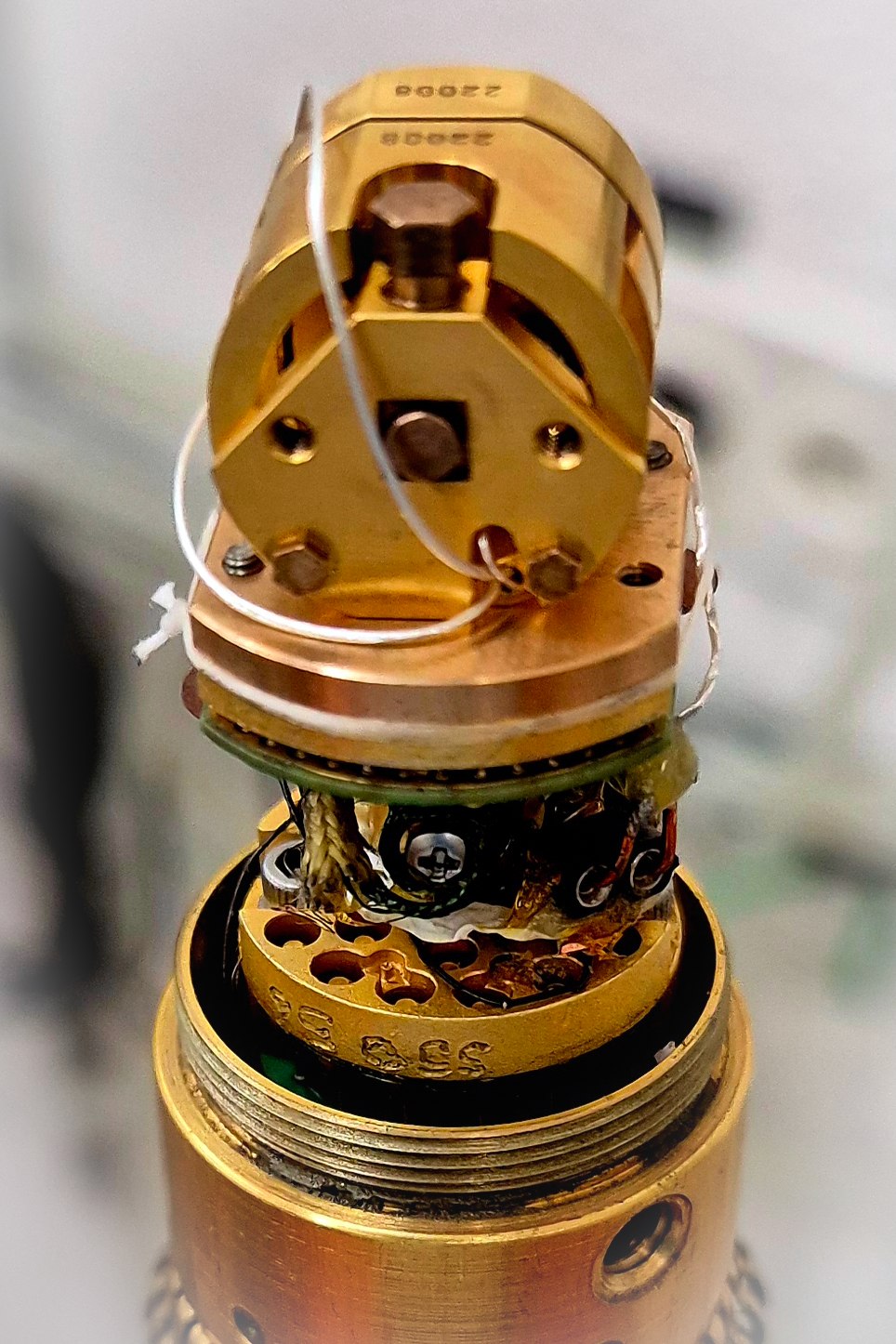
Dilatometry is simply the measurement of infinitesimal changes of sample dimensions as a function of some external parameter, such as magnetic field or temperature. At first glance, such experiments may seem irrelevant for magnetism. In truth, there always is some magneto-elastic coupling present: any change of the magnetic structure leads to a tiny expansion or shrinkage of the sample along one or several directions. These effects are minute indeed, but capacitive dilatometry is incredibly sensitive and easily detects relative dilations of 10-6 or smaller. In our experiments we have found dilatometry to be a particularly sensitive tool for detecting magnetic phase transitions and tracing magnetic phase boundaries. In our group we have a device that operates at temperatures down to 100 mK and in magnetic fields of up to 14 T.
A case in point is our study of the triangular-lattice antiferromagnet (CD3ND3)2NaRuCl6, which in an applied magnetic field goes through a whole cascade of ordered phases. In the raw magnetostriction data the corresponding anomalies are all but invisible: the total field-induced length change is a few parts in 100,000. In the field derivative, the magnetostriction coefficient, they show up as sharp, unmistakable spikes. It was data like these that allowed us to trace the complete magnetic phase diagram of this material, including the boundaries of the phase that we believe to be a "crystal" of ℤ2 vortices. For more details see J. Nagl, K. Yu. Povarov, B. Duncan, C. Näppi, D. Khalyavin, P. Manuel, F. Orlandi, J. Sourd, B. V. Schwarze, F. Husstedt, S. A. Zvyagin, O. Zaharko, P. Steffens, A. Hiess, D. Allan, S. Barnett, Z. Yan, S. Gvasaliya, A. Zheludev, Z2 vortex crystal candidate in the triangular quantum antiferromagnet , npj Quantum Mater. 11, 69 (2026); arXiv:2512.01793.

Field-induced magnetostriction of (CD3ND3)2NaRuCl6 measured with our dilatometer at temperatures between 0.12 K and 0.35 K (left), and its numerical field derivative, the magnetostriction coefficient λ (right). Triangles mark some of the phase transitions. Curves at different temperatures are offset for visibility.